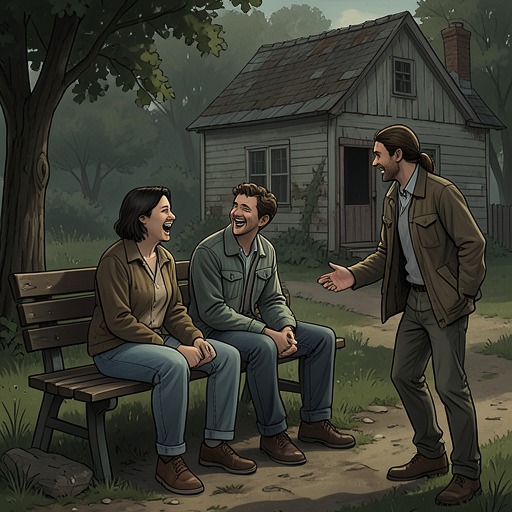
Axel and Wigwam
Down Cemetery RoadAxel and Wigwam’s marriage joined a sustained performance of domestic intimacy to a covert plan of murder. Living as Rufus, Axel married Wigwam and appeared to Sarah to be an unremarkable partner; in fact, he was waiting for Thomas Singleton to return so that he could kill him. The revelation does not make the relationship’s emotional meaning simple: Axel describes the marriage with contempt, while Sarah recognizes that six months of pretending to love Wigwam may still have mattered to her friend. Whether Wigwam survives is left uncertain, so the marriage ends in exposure without a settled account of what either partner felt.
The Marriage and Its False Identity
Axel’s relationship with Wigwam was conducted under the borrowed identity of Rufus. When he finally tells Sarah that his real name is Axel, he does so while shifting between his own face and an imitation of Gerard Inchon. The quick performance captures the instability of the identity Wigwam had married: the affable Rufus was not simply a private self but a role Axel could put on and take off. Sarah had thought of him as an airhead, yet the revelation makes clear that this apparent harmlessness was part of a much more deliberate concealment.
Axel says that he spent six months married to Wigwam. The duration matters: the deception was not a brief encounter or an improvised excuse, but a domestic arrangement maintained over time. Wigwam had children, and Axel’s place in her household gave his assumed identity the shape of ordinary family life. The available account does not establish what Wigwam knew about his past or whether she ever suspected him. It does show how little Sarah could recover about his arrival: in her recollection, Rufus had simply appeared, and she cannot remember how he first entered their lives.
Domestic Life as Operational Cover
The marriage served Axel’s larger purpose. He was waiting for Thomas Singleton to come back from the dead, in the sense that the world believed him dead but Axel expected him to reappear. Axel intended to send him back to the grave. Sarah understands the marriage as part of the cover that made this possible: Axel impersonated a family man in order to trap a man whose attachment to his wife and daughter would bring him back. The intimate household was therefore not incidental to the scheme. Its apparent normality concealed the danger surrounding Thomas’s return.
That purpose also gives the marriage a bitter asymmetry. For Wigwam, Rufus seemed to be a husband; for Axel, the husband’s role was bound up with a plan aimed at someone else. Axel tells Sarah that he would have left weeks earlier if circumstances had allowed, and speaks of his six months with Wigwam as an ordeal. His contempt strips away the gentleness Sarah had associated with Rufus, but it cannot prove that every gesture during the marriage was empty. What it establishes is the gap between the relationship as Wigwam appeared to live it and the purpose Axel privately assigned to it.
Wigwam’s Happiness and Sarah’s Revised Understanding
Sarah’s first response to the revelation is not a confident reconstruction but a recognition of how little she knew. Mark had seemed to look straight through her at the station; now, thinking of him alongside Rufus, she wonders whether she has ever truly known anyone. Rufus’s apparent harmlessness had been so complete that she cannot place his entrance into their circle. The disguise has erased not only Axel’s past but the point at which the person Sarah knew began to exist.
Yet Sarah does not reduce Wigwam’s happiness to a trick. She remembers that Wigwam had been happy for months and considers what it means that Axel sustained the role of her lover for so long. If Wigwam is alive, Sarah thinks she would grieve for Rufus despite what he had done, because no man in Wigwam’s past had cared enough for her to maintain such a pretence. This is not proof of Axel’s love: Sarah is reasoning from the visible duration of the performance, not from access to his private feelings. Her thought instead holds two truths in tension. Axel’s intimacy was instrumental, and the attention he gave Wigwam may nonetheless have been more than she had previously received from anyone.
Exposure and Unresolved Loss
Axel tells Sarah that Wigwam is dead, but Sarah cannot accept the claim as certain. She asks herself why he would have tried to kill her if he had not found the copy of Joe Silvermann’s letter, and cannot identify a reason he would have murdered Wigwam earlier. She therefore considers another possibility: that Axel wanted her to die believing her friend was already dead. The account leaves Wigwam’s fate unresolved, making Axel’s claim part of the threat and manipulation surrounding the exposure rather than a confirmed outcome.
The marriage’s end is consequently marked by uncertainty rather than a clean revelation. Axel’s true name and murderous purpose are exposed, and the domestic identity of Rufus collapses; but Sarah cannot know whether Wigwam is dead, nor can she settle what the sustained performance meant to Axel. She reaches a narrower certainty about her own response: if Wigwam is alive, she will grieve for Rufus, whatever he has done and whoever he proves to be. The relationship remains both a weapon used against Thomas Singleton and a loss Sarah cannot reduce to the deception that created it.